
2024 Risk of Job Displacement for Marketers with the Adoption of AI in Agile Marketing
I. Introduction
- Definition of Agile Marketing
- Overview of AI in Marketing
- The Intersection of AI and Agile Marketing
II. The Impact of AI on Marketing Jobs
- Current Landscape of Marketing Jobs
- Potential Risks with AI Adoption
- Analyzing the Displacement Factor
III. The Rise of Agile Marketing
- Understanding Agile Marketing Principles
- Benefits and Efficiency Gains
- AI's Role in Enhancing Agile Marketing
IV. The Symbiotic Relationship
- How AI and Agile Marketing Can Coexist
- Opportunities for Marketers in the Evolving Landscape
- Upskilling and Adapting to Technological Changes
V. Strategies for Marketers
- Embracing AI as a Tool
- Developing New Skill Sets
- Staying Relevant in an AI-Driven Marketing World
VI. Real-world Examples
- Companies Successfully Integrating AI and Agile Marketing
- Positive Outcomes and Lessons Learned
- Inspiration for Marketers Navigating the Change
VII. Overcoming Perplexity in AI Adoption
- Addressing Concerns and Fears
- Debunking Myths Surrounding AI in Marketing
- Creating a More Informed and Confident Workforce
VIII. Burstiness in Agile Marketing
- Leveraging AI for Dynamic Campaigns
- Responding Quickly to Market Changes
- Seizing Opportunities with Agility and Innovation
IX. The Future Landscape
- Predictions for the Role of AI in Marketing
- Evolving Job Descriptions in the Field
- Preparing for the Future Workplace
X. Conclusion
- Recap of Key Points
- Encouraging Adaptability and Embracing Change
FAQs (Frequently Asked Questions)
- Is AI completely taking over the role of marketers?
- How can marketers stay relevant in a rapidly changing landscape?
- Are there specific industries benefiting more from AI in marketing?
- What are the ethical considerations in AI-driven marketing?
- Are small businesses at a disadvantage with AI adoption in marketing?
In today's fast-paced digital landscape, the marriage of artificial intelligence (AI) and Agile Marketing is revolutionizing the way businesses reach and engage their target audience. However, with this transformative shift comes concerns about the risk of job displacement for marketers. In this article, we will explore the intricate relationship between AI and Agile Marketing, analyze the potential impact on marketing jobs, and provide strategies for marketers to navigate this evolving landscape.
I. Introduction
A. Definition of Agile Marketing
Agile Marketing is an iterative and flexible approach to marketing that values adaptability and responsiveness to change. It borrows principles from Agile software development, promoting collaboration, customer feedback, and quick responses to market dynamics.
B. Overview of AI in Marketing
AI in marketing involves the use of advanced technologies such as machine learning and data analytics to automate tasks, enhance personalization, and optimize marketing strategies.
C. The Intersection of AI and Agile Marketing
The convergence of AI and Agile Marketing creates a dynamic environment where data-driven decision-making meets nimble and responsive campaign execution.

II. The Impact of AI on Marketing Jobs
A. Current Landscape of Marketing Jobs
Marketers today engage in a diverse range of tasks, from creative content creation to data analysis. AI has the potential to automate routine tasks, leaving marketers to focus on strategic thinking and creativity.
B. Potential Risks with AI Adoption
While AI promises efficiency gains, there's concern about job displacement as automation takes over routine tasks. Marketers must adapt to remain valuable contributors to the marketing process.
C. Analyzing the Displacement Factor
Understanding the factors contributing to job displacement is crucial. AI adoption should be seen as an opportunity for growth and upskilling rather than a threat.
III. The Rise of Agile Marketing
A. Understanding Agile Marketing Principles
Agile Marketing emphasizes collaboration, adaptability, and customer-centricity. Marketers embracing Agile methodologies are better positioned to thrive in a rapidly changing landscape.
B. Benefits and Efficiency Gains
Agile Marketing enables teams to respond quickly to market changes, ensuring campaigns remain relevant. AI enhances this by providing real-time data insights for informed decision-making.
C. AI's Role in Enhancing Agile Marketing
AI complements Agile Marketing by automating data analysis, providing predictive analytics, and optimizing marketing campaigns for better results.
IV. The Symbiotic Relationship
A. How AI and Agile Marketing Can Coexist
Marketers need not see AI as a threat but rather as a powerful ally. Integrating AI tools allows marketers to focus on strategic thinking, creativity, and relationship-building.
B. Opportunities for Marketers in the Evolving Landscape
The evolving landscape presents new opportunities for marketers to specialize in AI-driven strategies, creating a demand for skilled professionals.
C. Upskilling and Adapting to Technological Changes
To remain relevant, marketers must invest in upskilling, embracing new technologies, and staying informed about industry trends.

V. Strategies for Marketers
A. Embracing AI as a Tool
Marketers can leverage AI tools for data analysis, audience segmentation, and campaign optimization, allowing for more effective and targeted marketing efforts.
B. Developing New Skill Sets
Acquiring skills in AI-related technologies ensures marketers stay competitive and contribute meaningfully to the evolving marketing landscape.
C. Staying Relevant in an AI-Driven Marketing World
Continuous learning and adaptation to emerging technologies are key for marketers to stay relevant and thrive in an AI-driven marketing world.
VI. Real-world Examples
A. Companies Successfully Integrating AI and Agile Marketing
Examining case studies of companies successfully implementing AI and Agile Marketing strategies provides insights and inspiration for marketers navigating change.
B. Positive Outcomes and Lessons Learned
Understanding the positive outcomes and lessons learned from early adopters helps marketers approach AI integration with confidence and a strategic mindset.
C. Inspiration for Marketers Navigating the Change
Real-world examples inspire marketers to see AI as an enabler, opening doors to creativity and innovation in their campaigns.
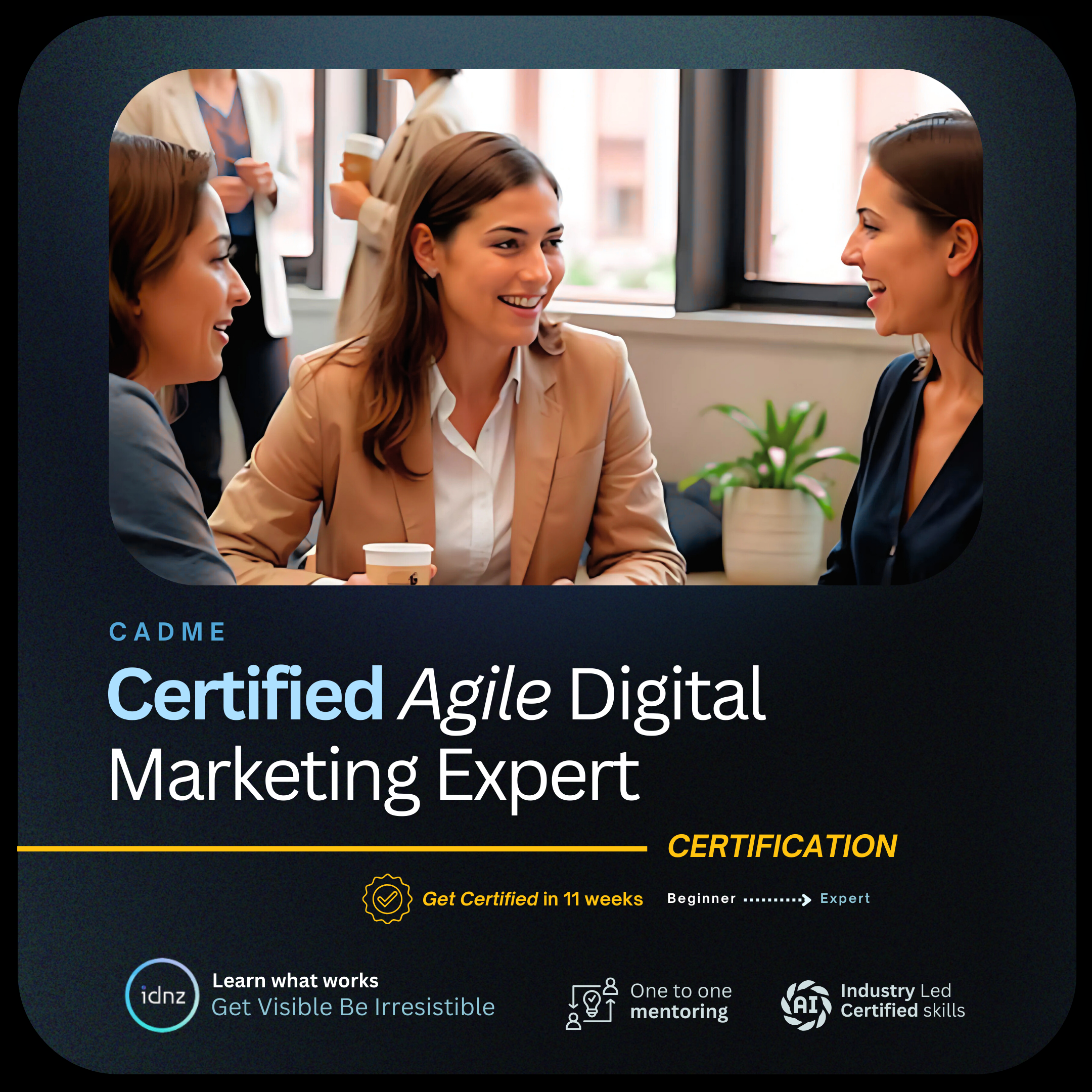
The Only Agile Digital Marketing Certification Built for the AI Era
The Certified Agile Digital Marketing Expert (CADME) is New Zealand’s first and only agile digital marketing certification — built for marketers who want to move beyond channels and into owning full-funnel strategy, AI systems, and business growth.
This isn’t a digital marketing course.
This is AI-powered, full-stack marketing strategy.
Across 11 hands-on sprints over 11 weeks, you’ll master:
SEO and search strategy that captures high-intent demand
Paid media across Google Ads and social platforms
AI-driven content systems that scale production and performance
Email marketing and lifecycle automation
Conversion optimisation (CRO) and high-performing landing experiences
Customer experience (CX), UX, and omni-channel journey design
Data analytics, attribution, and performance modelling
Budget planning, forecasting, and ROI defence
Delivered fully online with weekly one-to-one mentoring, CADME is built for real-world execution — using your business or a live case study.
Validated against platforms like Google, Meta, LinkedIn, and Microsoft — and designed to outperform outdated NZQA frameworks that haven’t kept pace with AI-driven marketing ecosystems.
Why Digital Marketing Is the Highest-Leverage Career Move in 2026
Digital marketing is no longer a collection of channels.
It’s a connected growth system.
And it’s being rewritten in real time.
AI is transforming how campaigns are created, optimised, and scaled
Businesses are shifting from channel-based execution to system-based growth
Customer journeys are now multi-touch, multi-platform, and data-driven
Companies are prioritising marketers who can connect strategy to revenue
The gap is widening fast.
Most marketers are still:
Running campaigns in silos
Chasing platform tactics
Reporting on disconnected metrics
The ones winning in 2026 are:
Designing end-to-end marketing ecosystems
Leveraging AI across every stage of the funnel
Connecting traffic → experience → conversion → retention
That’s where the career acceleration happens.
Where CADME Positions You
CADME sits at the exact inflection point between execution and leadership across the entire digital ecosystem.
It’s not another digital marketing course.
It’s a career leverage system that signals:
You understand how modern marketing actually works (AI + data + systems)
You can connect multiple channels into a unified growth strategy
You can drive measurable business outcomes, not just campaign metrics
You can lead marketing direction at a strategic level
This is what employers are hiring for now.
And what most marketers still can’t do.
Who CADME Is Built For
CADME is designed for professionals ready to step into high-impact, strategic marketing roles:
Digital marketers moving into strategist, manager, or leadership roles
Marketing managers who need full-stack capability across all channels
Business owners who want to build scalable, predictable growth systems
Agency professionals looking to move from execution into strategy
Traditional marketers upgrading into an AI-first, omni-channel environment
Graduates with experience aiming to accelerate into mid-senior roles faster
No coding. No fluff.
Just strategic, commercial, and system-level execution.
CADME vs CASME: Ecosystem Control vs Platform Mastery
If you’re deciding between certifications, here’s the reality:
CADME = Full ecosystem control
→ SEO, paid media, content, email, UX, analytics, AI systemsCASME = Platform depth (social)
→ Multi-platform strategy, AI content, social commerce, paid social
Most high-performers don’t choose one.
They stack them.
CADME builds ecosystem control.
CASME builds platform authority.
Together, they position you as a complete modern marketer.
VII. Overcoming Perplexity in AI Adoption
A. Addressing Concerns and Fears
Common concerns surrounding AI, such as job displacement, can be addressed through open communication, education, and a focus on the benefits of AI integration.
B. Debunking Myths Surrounding AI in Marketing
Dispel myths about AI in marketing by providing accurate information and showcasing success stories where AI enhances, rather than replaces, human skills.
C. Creating a More Informed and Confident Workforce
Investing in education and training creates a workforce that is not only technologically adept but also confident in navigating the AI landscape.
VIII. Burstiness in Agile Marketing
A. Leveraging AI for Dynamic Campaigns
AI enables marketers to create dynamic and responsive campaigns that capitalize on real-time data, ensuring marketing efforts are aligned with current market trends.
B. Responding Quickly to Market Changes
Agile Marketing, empowered by AI, allows marketers to respond swiftly to changes in consumer behavior, industry trends, and competitive landscapes.
C. Seizing Opportunities with Agility and Innovation
By embracing burstiness in Agile Marketing, marketers can seize opportunities quickly, fostering innovation and staying ahead in a dynamic market.
IX. The Future Landscape
A. Predictions for the Role of AI in Marketing
Exploring future trends and predictions for AI in marketing provides insights into the evolving role of marketers and the skills required in the years to come.
B. Evolving Job Descriptions in the Field
As AI becomes more integrated into marketing processes, job descriptions will evolve, creating opportunities for specialized roles and skills.
C. Preparing for the Future Workplace
Marketers should prepare for a future workplace where AI is a collaborator, focusing on continuous learning and adaptability to thrive in the evolving landscape.

X. Conclusion
A. Recap of Key Points
Summarizing the key takeaways, emphasizing the symbiotic relationship between AI and Agile Marketing, and highlighting the opportunities for marketers.
B. Encouraging Adaptability and Embracing Change
Encouraging a mindset shift towards adaptability and embracing change as essential elements for success in the ever-evolving field of marketing.
FAQs (Frequently Asked Questions)
Is AI completely taking over the role of marketers?
No, AI is a tool that enhances marketing efforts. While it automates certain tasks, human creativity, strategy,
and relationship-building remain crucial.
How can marketers stay relevant in a rapidly changing landscape?
Marketers can stay relevant by embracing AI, developing new skill sets, and continuously adapting to
emerging technologies through education and upskilling.
Are there specific industries benefiting more from AI in marketing?
Various industries, including e-commerce, finance, and healthcare, are benefiting from AI in marketing.
The key is adapting AI tools to industry-specific needs.
What are the ethical considerations in AI-driven marketing?
Ethical considerations include data privacy, transparency, and ensuring AI tools are used responsibly.
Marketers must prioritize ethical practices to build trust with consumers.
Are small businesses at a disadvantage with AI adoption in marketing?
Not necessarily. Many AI tools are scalable and adaptable for businesses of all sizes.
Small businesses can benefit by focusing on specific AI applications that align with their goals.
The landscape of marketing is evolving, driven by the dynamic synergy between AI and Agile Marketing. As we navigate through the complexities and burstiness of this transformation, marketers are presented with opportunities for growth, innovation, and specialization. Embracing change, staying informed, and developing new skills are the keys to not just surviving but thriving in the AI-driven marketing world.
In conclusion, the risk of job displacement is mitigated by viewing AI as a collaborative partner rather than a threat. Marketers who adapt, upskill, and integrate AI into their strategies will find themselves at the forefront of a rapidly changing industry. The future of marketing is not about replacing humans with machines but about creating a harmonious blend where human creativity and AI capabilities complement each other.