
Key Principles of Agile Marketing Communications

65% of customers prefer contacting businesses by phone. ref:goremotely
Agile Marketing Communications refers to the application of Agile principles and methodologies in the field of marketing and communications. Agile, originally developed for software development, emphasises collaboration, flexibility, and iterative processes to achieve better results. When adapted to marketing communications, it allows teams to respond quickly to changing market conditions, customer preferences, and emerging trends.
Key Principles of Agile Marketing Communications:
Cross-Functional Collaboration: Agile marketing teams consist of members with diverse skills such as designers, writers, marketers, and data analysts. This encourages collaboration and knowledge-sharing across different functions.
Iterative Planning: Instead of rigid long-term planning, Agile marketing involves short, focused planning cycles (often called sprints) where teams determine their goals and priorities for the upcoming period.
Flexibility: Agile marketing embraces change. Teams are prepared to adjust strategies, campaigns, and tactics based on real-time feedback and market shifts.
Customer-Centric Approach: Agile marketing emphasizes understanding customer needs and preferences. Regular feedback from customers informs marketing decisions and helps refine campaigns.
Data-Driven Decision Making: Analytics and data play a central role in Agile marketing. Teams rely on data insights to evaluate the success of campaigns and make informed decisions.
Continuous Improvement: After each sprint or campaign, teams conduct retrospectives to identify what worked well and areas for improvement. Lessons learned are applied to future projects.
Quick Adaptation: Agile marketing allows teams to quickly pivot or adjust strategies based on emerging opportunities or unexpected challenges.
Benefits of Agile Marketing Communications:
Faster Time-to-Market: Agile methods enable quicker campaign deployment, reducing the time between ideation and execution.
Improved Campaign Performance: Regular feedback loops and data-driven decision-making lead to more effective campaigns and higher ROI.
Enhanced Collaboration: Cross-functional teams foster better communication and shared understanding, leading to more innovative and holistic marketing strategies.
Better Resource Allocation: Agile marketing focuses resources on high-impact activities by prioritizing tasks based on value and urgency.
Adaptation to Change: Agile marketing ensures organizations remain agile and responsive in the face of rapidly changing market dynamics.
Increased Customer Satisfaction: A customer-centric approach results in marketing efforts that better resonate with target audiences.

78% of mobile phone users ages 18 to 29 regularly use their cell phones to access the internet, compared with only 20% of those 50 or older. Similarly, in the U.S., 73% of 18-29 year-olds use their cell phone for the internet, compared with 49% of 30-49 year-olds and 21% of those 50 or older. Young people are also consistently more likely to use their cell phones for texting and taking pictures or video. ref: Pewresearch
Implementing Agile Marketing Communications:
Training and Education: Ensure that team members understand Agile principles and methodologies. Training sessions can help build a common language and understanding.
Cross-Functional Teams: Form multidisciplinary teams that bring together diverse skills needed for effective marketing campaigns.
Regular Sprints: Adopt a regular cadence for planning, executing, and reviewing campaigns. Sprints could be weekly, bi-weekly, or monthly, depending on the organization's needs.
Data Analytics and Insights: Invest in robust data analytics tools to gather insights and track campaign performance.
Feedback Loops: Establish mechanisms for receiving and acting upon feedback from customers and internal stakeholders.
Continuous Learning: Encourage a culture of continuous learning and improvement through regular retrospectives and knowledge sharing.
Agile Marketing Communications enables marketing teams to be more adaptable, customer-focused, and responsive in today's dynamic and rapidly evolving business landscape.
FAQ’s
1. What is Agile Marketing Communications?
Agile Marketing Communications refers to the application of Agile principles and methodologies in the field of marketing and communications, allowing for flexibility and rapid adaptation in strategies and campaigns.
2. How does Agile Marketing differ from traditional marketing?
Agile Marketing is characterized by its iterative approach, quick adaptation to change, and cross-functional collaboration, whereas traditional marketing often follows linear processes and longer planning cycles.
3. What are the key benefits of using Agile in marketing?
Agile marketing leads to faster campaign deployment, improved performance, enhanced collaboration, better resource allocation, and increased customer satisfaction.
4. What is a sprint in Agile Marketing Communications?
A sprint is a focused, time-boxed period during which a marketing team works on a set of predefined tasks, often lasting one to four weeks, to achieve specific goals.
5. How does Agile Marketing encourage collaboration?
Agile Marketing involves cross-functional teams with diverse skills, fostering better communication, shared understanding, and collaborative decision-making.
6. What role does data play in Agile Marketing Communications?
Data-driven decision-making is central to Agile Marketing, as teams rely on analytics and insights to evaluate campaign performance and make informed choices.
7. How often should Agile Marketing teams review their campaigns?
Agile Marketing teams typically conduct regular reviews at the end of each sprint or campaign to assess what worked well and identify areas for improvement.
8. Can Agile Marketing work for both B2B and B2C businesses?
Yes, Agile Marketing can be adapted to suit the needs of both B2B and B2C businesses, as it focuses on customer-centricity and rapid adaptation.
9. Is Agile Marketing suitable for small businesses?
Yes, Agile Marketing can be particularly beneficial for small businesses, allowing them to respond quickly to market changes with limited resources.
10. How does Agile Marketing handle changing market trends?
Agile Marketing's flexibility allows teams to pivot and adjust strategies swiftly in response to changing market trends, ensuring relevance and effectiveness.
11. What are the key challenges in implementing Agile Marketing Communications?
Challenges can include shifting to a collaborative mindset, aligning stakeholders, and adapting to frequent changes in project direction.
12. Can Agile Marketing be combined with other marketing methodologies?
Yes, Agile Marketing can be combined with other methodologies like Lean or Design Thinking to create a hybrid approach that suits an organization's needs.
13. How does Agile Marketing support innovation?
Agile Marketing encourages experimentation and iterative improvement, fostering an environment where innovative ideas can be tested and refined quickly.
14. What is the role of a Scrum Master in Agile Marketing?
The Scrum Master is responsible for facilitating the Agile process, removing obstacles, and ensuring the team follows Agile practices effectively.
15. Is Agile Marketing suitable for long-term marketing strategies?
Agile Marketing is often more focused on short to medium-term strategies, but it can also be adapted for long-term goals by breaking them down into manageable increments.
16. How can Agile Marketing benefit content creation?
Agile Marketing ensures that content creation aligns with changing audience needs and preferences, resulting in more relevant and engaging materials.
17. Can Agile Marketing improve return on investment (ROI)?
Yes, Agile Marketing's data-driven approach and focus on continuous improvement can lead to more effective campaigns and higher ROI.
18. How does Agile Marketing handle unexpected challenges?
Agile Marketing teams are well-equipped to handle unexpected challenges by quickly reassessing strategies and adapting their approach as needed.
19. Are there any industries where Agile Marketing is particularly effective?
Agile Marketing can be effective across various industries, especially those with rapidly changing trends and customer preferences, such as technology and fashion.
20. What steps can a company take to transition to Agile Marketing Communications?
Transitioning to Agile Marketing involves training teams, setting up cross-functional groups, implementing regular sprints, investing in data analytics, and fostering a culture of collaboration and continuous learning.
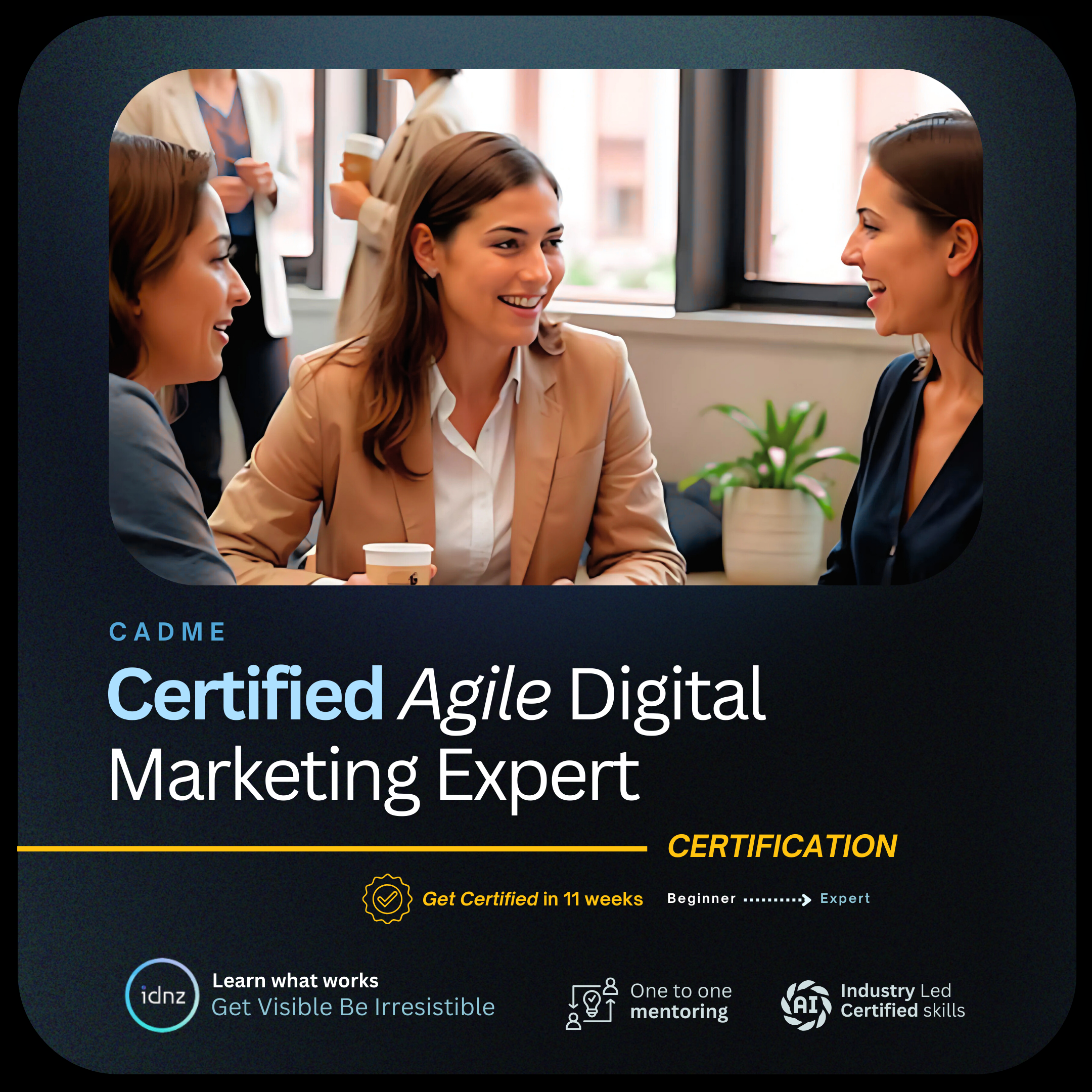
The Only Agile Digital Marketing Certification Built for the AI Era
The Certified Agile Digital Marketing Expert (CADME) is New Zealand’s first and only agile digital marketing certification — built for marketers who want to move beyond channels and into owning full-funnel strategy, AI systems, and business growth.
This isn’t a digital marketing course.
This is AI-powered, full-stack marketing strategy.
Across 11 hands-on sprints over 11 weeks, you’ll master:
SEO and search strategy that captures high-intent demand
Paid media across Google Ads and social platforms
AI-driven content systems that scale production and performance
Email marketing and lifecycle automation
Conversion optimisation (CRO) and high-performing landing experiences
Customer experience (CX), UX, and omni-channel journey design
Data analytics, attribution, and performance modelling
Budget planning, forecasting, and ROI defence
Delivered fully online with weekly one-to-one mentoring, CADME is built for real-world execution — using your business or a live case study.
Validated against platforms like Google, Meta, LinkedIn, and Microsoft — and designed to outperform outdated NZQA frameworks that haven’t kept pace with AI-driven marketing ecosystems.
Why Digital Marketing Is the Highest-Leverage Career Move in 2026
Digital marketing is no longer a collection of channels.
It’s a connected growth system.
And it’s being rewritten in real time.
AI is transforming how campaigns are created, optimised, and scaled
Businesses are shifting from channel-based execution to system-based growth
Customer journeys are now multi-touch, multi-platform, and data-driven
Companies are prioritising marketers who can connect strategy to revenue
The gap is widening fast.
Most marketers are still:
Running campaigns in silos
Chasing platform tactics
Reporting on disconnected metrics
The ones winning in 2026 are:
Designing end-to-end marketing ecosystems
Leveraging AI across every stage of the funnel
Connecting traffic → experience → conversion → retention
That’s where the career acceleration happens.
Where CADME Positions You
CADME sits at the exact inflection point between execution and leadership across the entire digital ecosystem.
It’s not another digital marketing course.
It’s a career leverage system that signals:
You understand how modern marketing actually works (AI + data + systems)
You can connect multiple channels into a unified growth strategy
You can drive measurable business outcomes, not just campaign metrics
You can lead marketing direction at a strategic level
This is what employers are hiring for now.
And what most marketers still can’t do.
Who CADME Is Built For
CADME is designed for professionals ready to step into high-impact, strategic marketing roles:
Digital marketers moving into strategist, manager, or leadership roles
Marketing managers who need full-stack capability across all channels
Business owners who want to build scalable, predictable growth systems
Agency professionals looking to move from execution into strategy
Traditional marketers upgrading into an AI-first, omni-channel environment
Graduates with experience aiming to accelerate into mid-senior roles faster
No coding. No fluff.
Just strategic, commercial, and system-level execution.
CADME vs CASME: Ecosystem Control vs Platform Mastery
If you’re deciding between certifications, here’s the reality:
CADME = Full ecosystem control
→ SEO, paid media, content, email, UX, analytics, AI systemsCASME = Platform depth (social)
→ Multi-platform strategy, AI content, social commerce, paid social
Most high-performers don’t choose one.
They stack them.
CADME builds ecosystem control.
CASME builds platform authority.
Together, they position you as a complete modern marketer.